
80s photo trend
The 80s Trend in 2026
The photo trend that has been moving through feeds since late August: where it started, why the images look the way they do, and how to make your own without spending an afternoon on it.
4.6average rating · 4,109 App Store
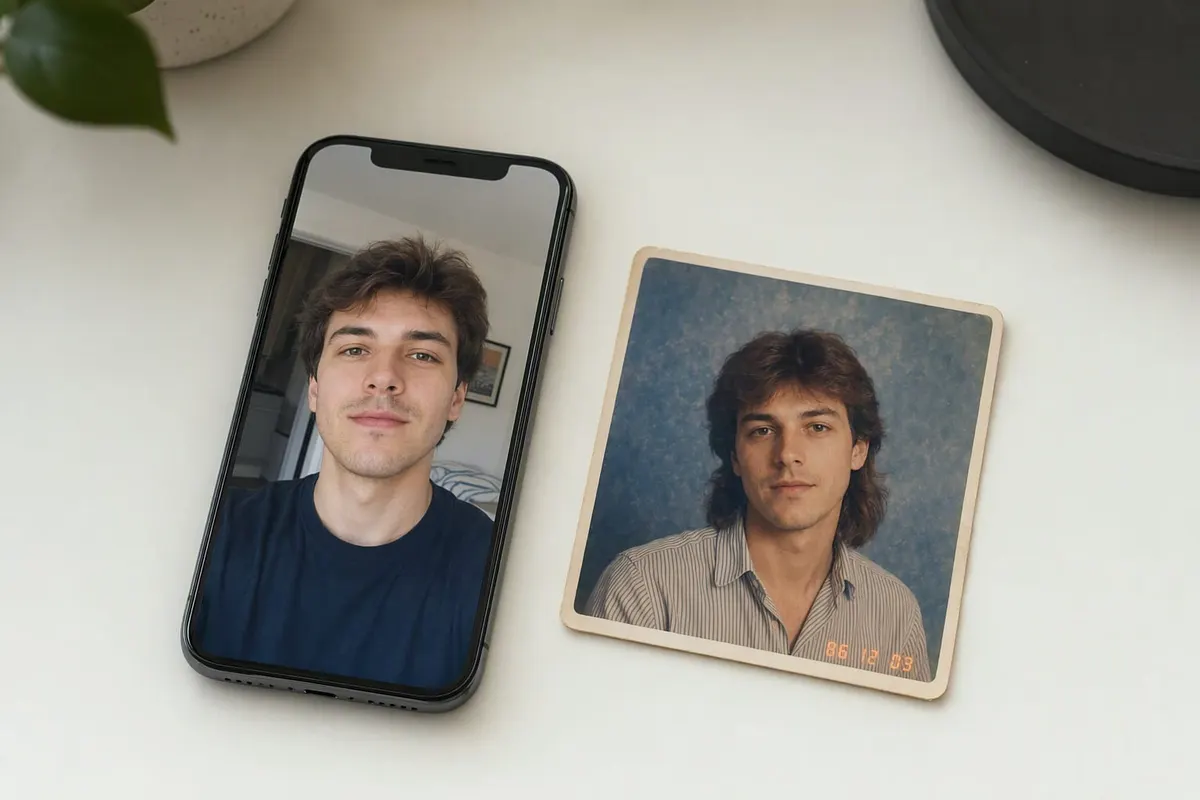
What the 2026 80s trend is
It is a photo trend: you take a current picture of yourself, have an AI restyle it as if it had been taken in 1986, and post the two side by side. Your face stays the same, which is the whole point — the comparison only works if the person in the 80s photo is recognisably you.
It started in late August 2026 in India and Pakistan, where actors, cricketers and politicians posted their 80s versions. Within days it moved through Brazil, Spain, Mexico and Turkey, then into the Gulf, Greece, Germany and Switzerland, and it is now running in the US, the UK, Australia and New Zealand. Search interest for the Portuguese phrasing alone rose about fiftyfold week on week at the peak.
Three tools do it: an app with the style built in, which takes seconds and needs no prompt; ChatGPT; and Gemini, both of which need a written prompt and a couple of attempts. The section below covers what actually makes a photo read as 1986, which is worth knowing whichever route you take.
Making your own
Pick a clear photo
Face front-on and sharp, daylight, no sunglasses, no beauty filter. A selfie is fine. For couples and groups, no face hidden behind another.
Restyle it
In FaceCast, tap the 80s style — a few seconds, no prompt. In ChatGPT or Gemini, attach the photo and paste a prompt that locks your face before listing what may change.
Post the pair and label it
After first, original second. Add the platform’s AI label and say so in the caption.
Why the images read as 1986 and not as a costume
The flash
A compact camera’s on-camera flash: bright flat face, hard edge at the hairline, short dark shadow behind the shoulder. This is the first thing the eye reads.
The grain
Fine, even grain from 200 or 400 ASA colour negative film, a little stronger in the shadows than in the highlights.
The colour shift
Reds and yellows hold, blues drift towards green, shadows pick up magenta — how a print ages in an album over thirty years.
The hair
Height and volume: perms, blow-dried feathered cuts, mullets, deep side parts. The single biggest period marker.
The backdrop
The mottled blue-grey canvas from a portrait studio, often with two or three thin laser streaks — or a wood-panelled living room with a tube television.
How it compares to the trends before it
It follows the AI yearbook wave of 2023 and the Ghibli restyling of 2025, and it works for the same reasons: one image tells the whole story, the before-and-after fits in a single swipe, and the subject is someone the viewer already knows. What is different in 2026 is the speed of the tools — a result that took an upload, a wait and a paid pack in 2023 now takes a few seconds and no payment.
The second difference is regulatory. Since 2 August 2026, Article 50 of the EU AI Act requires realistic AI images to be identifiable as AI-generated, and the platforms have their own labels on top of that. Posting an 80s portrait without a label is now a legal question in the EU, not just an etiquette one.
The variants people are posting
Couples
The studio portrait couples actually sat for — both faces travel, one backdrop, one hard flash.
Parents in their twenties
Restyling a photo of your parents to the decade they were young in. The most-shared variant in Brazil and Mexico.
Mother and daughter
Two generations in the same 1986 frame.
With the dog
The pet stays exactly as it is; the bandana is the only period detail it gets.
Office and gym
Shoulder pads and big frames for the desk portrait; leg warmers and neon for the aerobics years.
Common questions
What is the 80s trend of 2026?+
A photo trend: you restyle a current photo of yourself so it looks like it was taken in 1986 — hair, clothes, backdrop, flash and film grain — and post it next to the original. Your face stays the same.
When did the 80s trend start?+
Late August 2026, in India and Pakistan, spreading through Brazil, Spain, Mexico, Turkey, the Gulf, Greece and Germany before reaching the US, UK and Australia in September.
What app is everyone using for it?+
FaceCast has the style built in and takes seconds with no prompt; ChatGPT and Gemini also do it but need a written prompt and usually a few attempts.
Is the 80s trend free?+
FaceCast is free to download on iOS and Android. ChatGPT and Gemini both have free tiers that can produce the look.
Do I have to label the photo as AI?+
Yes. Use the platform’s AI label and mention it in the caption. In the EU, Article 50 of the AI Act has required it since 2 August 2026 for images realistic enough to be mistaken for real photographs.
Will the result actually look like me?+
It should — identity preservation is the point of the style. If a prompted result comes back as a stranger, the prompt did not lock the face in its first sentence.
Make your own 80s photo
One photo, a few seconds, your face intact. Free for iOS and Android.
4.6average rating · 4,109 App Store